

___________________________________________________________________________________________
China’s economy continues to send mixed signals. Manufacturing and exports remain relatively strong, but the sectors mostimportant to New Zealand timber exporters – residential construction andproperty development – are under considerable pressure. More broadly, decliningfixed asset investment (FAI) points to a weakening of one of the traditionalengines of China’s economic growth.
FAI measures investment in physical assets across the economy, including buildings, infrastructure,machinery and equipment. Historically, investment has been a major contributor to China’s economic growth, with gross capital formation at times accounting for more than 40% of GDP. Investment has supported industrialisation,infrastructure development and urbanisation, creating employment and raising household incomes while stimulating demand for housing and other property-related development.
FAI is also an important indicator of future timber demand. Wood products are used in a range of construction applications, including concrete formwork, structural components and building fit-outs. Consequently, changes in investment activity have direct implications for the consumption of timber and imported logs.
Figure 1. China Fixed Asset Investment
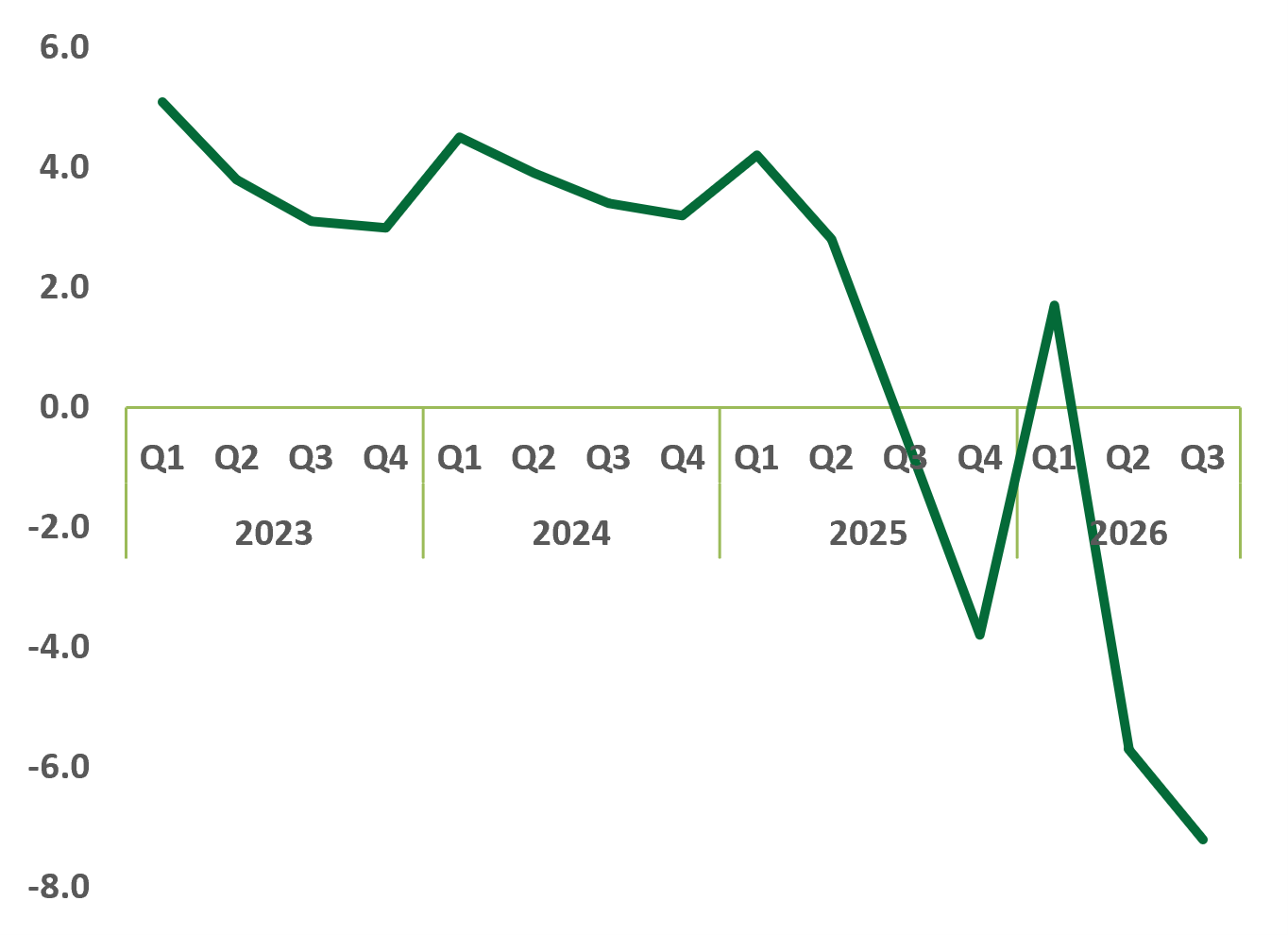
However, investment growth has weakened considerably in recentyears. Average annual FAI growth was approximately 4% for much of the 2020s.This began to slow in mid-2025, eventually turning negative. Althoughinvestment briefly returned to positive growth in early 2026, the downwardtrend subsequently resumed. By September 2026, cumulative FAI for the year wasdown 7.2% compared with the same period last year.
This represents a significant deterioration, particularlygiven that China's economy is still expected to grow by between 4.4% and 4.6%in 2026. The divergence highlights an important feature of China's changingeconomy: GDP growth is increasingly being supported by activities other thantraditional fixed investment.
The combination of weaker construction demand increased domestic production andgreater price competition is therefore changing the competitive environment for imported timber. Even if China's overall economy continues to grow, the sectors generating that growth may provide considerably less support for timber consumption than in the past.
The decline in FAI has been broad-based. It was not simply the result of reduced government spending; private businesses have also become more cautious about committing capital. The property sector has been particularly hard hit, with investment slowing by 20.6% for the year to September 2026 compared with the same period the previous year.
The decline in property investment is a continuation of the downturn that followed China's housing market correction in 2021. A large inventory of unsold properties and unfinished developments has undermined confidence among buyers and investors. Falling property prices have further weakened incentives for developers to initiate new projects.
The consequences extend well beyond the property sector itself. Lower construction activity has reduced demand for building materials,furniture and fittings, while the contraction in property-related activity has affected employment and businesses throughout the construction supply chain.
Local governments have also been affected. Their reliance on revenue from land sales and property-related taxes has constrained their ability to finance infrastructure and other economic development programs. Thishas added another source of weakness to investment across the economy.
The downturn has also affected household consumption. Falling property values have eroded household wealth, encouraging people tosave more and spend less. Weaker consumption, in turn, affected business revenues, employment and income growth, reinforcing the broader economicslowdown.
The government has introduced measures to encourage home purchases and support the property market. However, these initiatives have sofar done little to restore developer confidence or generate a sustained recovery in investment. A more substantial improvement may require government to assist developers in repairing their balance sheets, reduce debt and clear existing housing inventories before committing to significant new projects.
The scale of the property correction also suggests that recovery may take considerable time. Comparisons with previousproperty downturns in Japan and the United States suggest that China could still be some way from completing its adjustment. However, the extent of any further correction will depend on the effectiveness of government interventionand the underlying demand for housing.
China's total timber demand has declined over the past three years, largely reflecting weaker construction activity. This has contributed to a gradual reduction in timber consumption, resulting in slower withdrawals from port and inland railway inventories. However, port inventories have remained relatively balanced, as lower consumption has been accompanied by a corresponding reduction in shipments.
With demand weakening, the market has become increasingly price-sensitive and competition among timber suppliers has intensified.Exporters operating longer and more expensive supply chains have been particularly exposed, as Chinese buyers have become less willing to pay premiums for imported timber.
Competition has also increased because of the steady expansion of China's domestic timber production. As domestic suppliers capture a larger share of a contracting market, imported timber faces additional pressure. This is particularly relevant for New Zealand exporters, whose products must compete not only with other imported timber but also with an increasingly available domestic supply.
New Zealand has nevertheless maintained relatively stable export volumes. However, this has not prevented adjustments within the forestry sector. Lower prices and tighter margins have reduced the economic viability of harvesting higher-cost forests, particularly those involving steep terrain orlong transport distances to export ports.
The combination of weaker construction demand, increased domestic production and greater price competition is therefore changing the competitive environment for imported timber. Even if China's overall economy continues to grow, the sectors generating that growth may provide considerably less support for timber consumption than in the past.
Figure 2. Softwood log & lumber Imports in the first six months (H1)
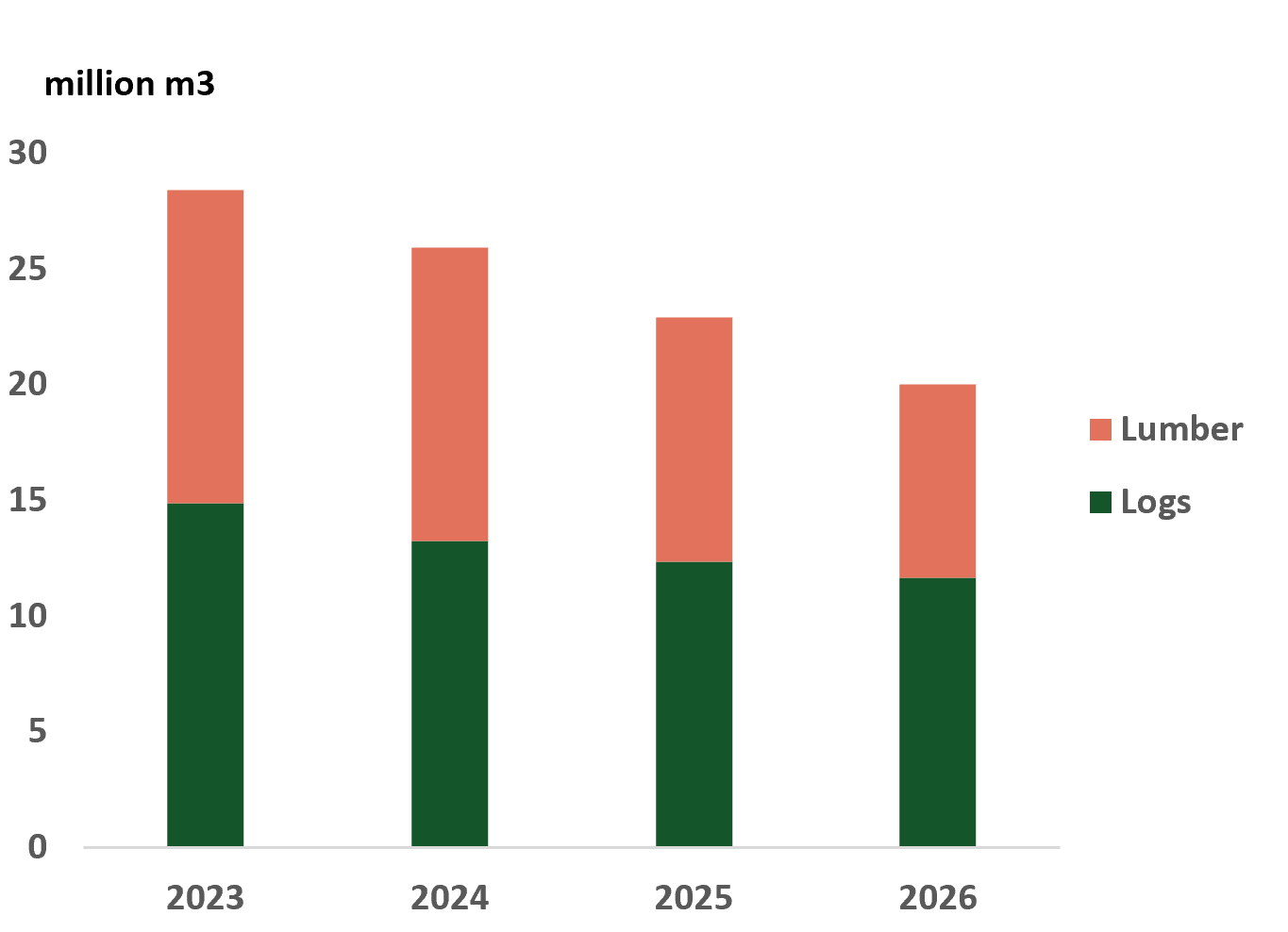
Despite the current weakness, there are reasons to expectsome recovery in China's timber demand over the medium term. The property market correction will eventually run its course, while lower housing prices, government support measures and the need to complete unfinished developmentsshould help restore confidence and construction activity. Urban redevelopment,housing replacement and infrastructure investment will also provide sources ofdemand, even if new residential construction remains below previous levels.
A recovery does not necessarily require a return to theinvestment-led growth model that characterised China over the past two decades.As the economy adjusts, demand for timber will increasingly be supported by a broader range of activities, including renovation, refurbishment, furniture manufacturing and infrastructure development. For imported timber suppliers, however, the benefits of any recovery will depend on their ability to compete with China's expanding domestic production. New Zealand remains well positioned in terms of established supply chains, consistent product availability and the suitability of radiata pine for a range of processing applications, particularly if domestic production cannot fully satisfy the demand for the grades andspecifications required by processors. While the market is unlikely to returnto the conditions experienced during China's construction boom, a stabilisation in property activity and gradual improvement in construction demand should provide opportunities for imported timber over the medium term. The recovery however, is likely to be more competitive and price sensitive than previous cycles
Looking ahead, understanding how changes in Chinese demand translate into New Zealand log prices and harvesting opportunities will be increasingly important for forest owners and investors. We assist forest managers and investors by providing independent forecasts of New Zealand timber supply and prices, supported by detailed market analysis and an understanding of the economic drivers shaping domestic and international markets. These insights help clients make more informed harvesting, investment and long-term strategic decisions